Clarence Gardens, 2022–23
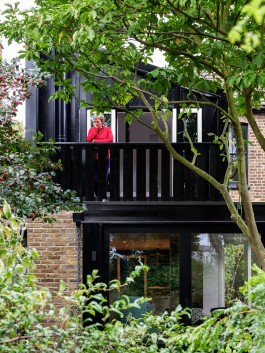
Clarence Gardens, part of the Regent’s Park Estate in Camden, was built in the 1950s around an earlier square, following the demolition of Regency terraces that were damaged during WWII.
Camden Town Group artists Harold Gilman and William Ratcliffe both made paintings of Clarence Gardens in the 1910s. The modernist replacement retains the form of the earlier square.
It was designed by Edward Armstrong and Frederick MacManus and is a mix of flats, maisonettes and terraced houses, built to a density of around 200 people per acre.


We were asked to remodel a one-bedroom flat at the end of a short terrace. The flat is oriented east-west, with living room, kitchen, bedroom and bathroom separated by non-loadbearing partitions.


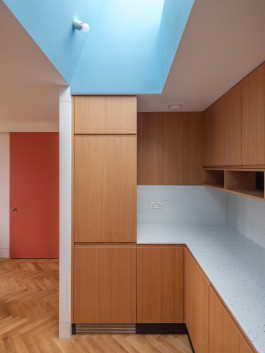
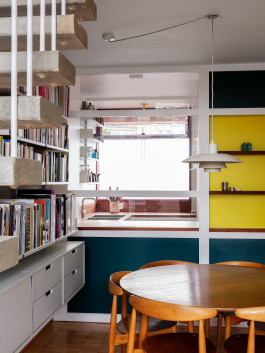
We removed the partition between living room and kitchen and made an opening between living room and bedroom, designed to be closed when required by a sliding panel. An existing blocked window opening in the south elevation was also re-opened to the bedroom.
The resulting, more open-plan, layout extends the feeling of space, and allows light to permeate the rooms at different times of the day.

Existing plan

Remodelled ground floor plan


Worm's eye view
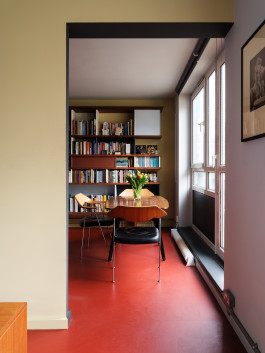
A continuous linoleum floor finish is used throughout the living spaces, and the walls and ceiling are painted as a series of plains that extend the perception of volume and connect the different areas. The colour palette is based upon Le Corbusier’s first colour polychromy of 1931, and colour defines the character of the spaces.

The building is concrete-framed and walls are hollow clay block. To avoid services chases in this fragile material, all re-wiring of power and lighting is surface-mounted and carefully composed. Fixtures and fittings are carefully chosen: the ironmongery, for example, is a design by Hans Poelzig, in satin aluminium, and very similar to the Wehag ironmongery popular in the 1950s (used at Golden Lane Estate and for many Span housing developments).


The kitchen design references the modular kitchens designed by Charlotte Perriand for the Unite d’Habitation de Marseille. The book shelving also takes inspiration from Perriand’s Nuage bookcase designed in the early 1950s.
The bathroom has been refitted as a wetroom, using a small format glazed tile and continuing the use of colour.
All building services were renewed; and the existing heating and hot water system was replaced with an all-electric system.


Related projects:
Clarence Gardens, 2022–23
Clarence Gardens, part of the Regent’s Park Estate in Camden, was built in the 1950s around an earlier square, following the demolition of Regency terraces that were damaged during WWII.
Camden Town Group artists Harold Gilman and William Ratcliffe both made paintings of Clarence Gardens in the 1910s. The modernist replacement retains the form of the earlier square.
It was designed by Edward Armstrong and Frederick MacManus and is a mix of flats, maisonettes and terraced houses, built to a density of around 200 people per acre.


We were asked to remodel a one-bedroom flat at the end of a short terrace. The flat is oriented east-west, with living room, kitchen, bedroom and bathroom separated by non-loadbearing partitions.


We removed the partition between living room and kitchen and made an opening between living room and bedroom, designed to be closed when required by a sliding panel. An existing blocked window opening in the south elevation was also re-opened to the bedroom.
The resulting, more open-plan, layout extends the feeling of space, and allows light to permeate the rooms at different times of the day.

Existing plan

Remodelled ground floor plan


Worm's eye view
A continuous linoleum floor finish is used throughout the living spaces, and the walls and ceiling are painted as a series of plains that extend the perception of volume and connect the different areas. The colour palette is based upon Le Corbusier’s first colour polychromy of 1931, and colour defines the character of the spaces.

The building is concrete-framed and walls are hollow clay block. To avoid services chases in this fragile material, all re-wiring of power and lighting is surface-mounted and carefully composed. Fixtures and fittings are carefully chosen: the ironmongery, for example, is a design by Hans Poelzig, in satin aluminium, and very similar to the Wehag ironmongery popular in the 1950s (used at Golden Lane Estate and for many Span housing developments).


The kitchen design references the modular kitchens designed by Charlotte Perriand for the Unite d’Habitation de Marseille. The book shelving also takes inspiration from Perriand’s Nuage bookcase designed in the early 1950s.
The bathroom has been refitted as a wetroom, using a small format glazed tile and continuing the use of colour.
All building services were renewed; and the existing heating and hot water system was replaced with an all-electric system.


Related projects: