Historical Association, 2023–24
The Historical Association, a registered charity, was founded in 1906 to support the growing need for good history resources in schools; and to further the study and investigation of history for all.
Today the Association supports the teaching and learning of history at all levels, and brings together people who share an interest in and love for the past.
It is run by a small team in Kennington, London, who support more than 45 branches of volunteers; organising programmes, events, lectures, and activities across the UK.


Existing plan

We were asked to remodel and refurbish the Historical Association’s existing offices; to create a more flexible workspace for their team, and to provide a flexible space for hosting outside events and seminars.

Remodelled plan

Remodelled plan (with seminar seating)
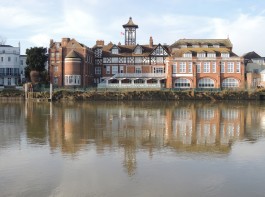
The accommodation is at the lower-ground floor of a Victorian former vicarage. The building had been converted in the late 1960s, and the Historical Association had occupied the space since this date. The offices were spread through a series of rooms that were once the kitchen, pantry and other associated ‘below stairs’ uses, and the cellular layout wasn’t suited to collaborative working.

The ongoing upkeep had been piecemeal, and the workspace had a tired appearance. Windows and joinery were in poor condition, and the walls exhibited signs of damp; with moisture being held behind gypsum-based plaster that had been used at the time of the 1960s conversion.
Alongside the remodelling work, the project rectified ongoing technical issues, using breathable materials and replacing windows and external doors.


Following a review of the team’s needs and working practices, the space was reconfigured with carefully directed interventions that removed sections of internal walls; to provide links between areas, and also helping to make better use of previously underutilised areas.

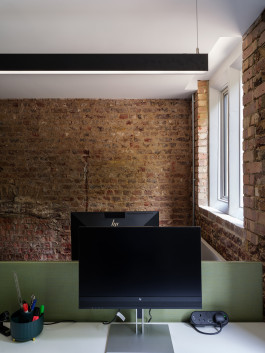
All of the existing plaster finishes were removed, back to the underlying brickwork. Some of the walls were lime plastered, and finished with a breathable clay paint. Other walls were left as exposed brick, and in places show signs of earlier alterations and past features.


Materials were salvaged and reused where possible. Yorkstone flags, taken from a former pantry that was removed to form part of the seminar space, were re-used in the entrance lobby and outside the front door. Victorian quarry tiles were restored in-situ in WCs, and where present elsewhere were retained below new floor finishes. Existing fitted timber shelving was carefully dismantled, adapted and reused.


The project also included the specification of all new furniture and associated fittings. The heating and hot water system was replaced with an all-electric system, and all electrical services were replaced, including a user-oriented heating and lighting control system.


Related projects:
Historical Association, 2023–24
The Historical Association, a registered charity, was founded in 1906 to support the growing need for good history resources in schools; and to further the study and investigation of history for all.
Today the Association supports the teaching and learning of history at all levels, and brings together people who share an interest in and love for the past.
It is run by a small team in Kennington, London, who support more than 45 branches of volunteers; organising programmes, events, lectures, and activities across the UK.


Existing plan

We were asked to remodel and refurbish the Historical Association’s existing offices; to create a more flexible workspace for their team, and to provide a flexible space for hosting outside events and seminars.

Remodelled plan (with seminar seating)

Remodelled plan
The accommodation is at the lower-ground floor of a Victorian former vicarage. The building had been converted in the late 1960s, and the Historical Association had occupied the space since this date. The offices were spread through a series of rooms that were once the kitchen, pantry and other associated ‘below stairs’ uses, and the cellular layout wasn’t suited to collaborative working.

The ongoing upkeep had been piecemeal, and the workspace had a tired appearance. Windows and joinery were in poor condition, and the walls exhibited signs of damp; with moisture being held behind gypsum-based plaster that had been used at the time of the 1960s conversion.
Alongside the remodelling work, the project rectified ongoing technical issues, using breathable materials and replacing windows and external doors.

Existing and new wall finishes


Following a review of the team’s needs and working practices, the space was reconfigured with carefully directed interventions that removed sections of internal walls; to provide links between areas, and also helping to make better use of previously underutilised areas.


All of the existing plaster finishes were removed, back to the underlying brickwork. Some of the walls were lime plastered, and finished with a breathable clay paint. Other walls were left as exposed brick, and in places show signs of earlier alterations and past features.


Materials were salvaged and reused where possible. Yorkstone flags, taken from a former pantry that was removed to form part of the seminar space, were re-used in the entrance lobby and outside the front door. Victorian quarry tiles were restored in-situ in WCs, and where present elsewhere were retained below new floor finishes. Existing fitted timber shelving was carefully dismantled, adapted and reused.


The project also included the specification of all new furniture and associated fittings. The heating and hot water system was replaced with an all-electric system, and all electrical services were replaced, including a user-oriented heating and lighting control system.


Related projects: